I have been chasing the northern lights from southern Finland since 2011. Not from Lapland, where they hang overhead like a rumour that came true, but from Uusimaa, where you earn every single show. That constraint taught me more than easy skies ever would.
Here is what I wish someone had told me at the start.
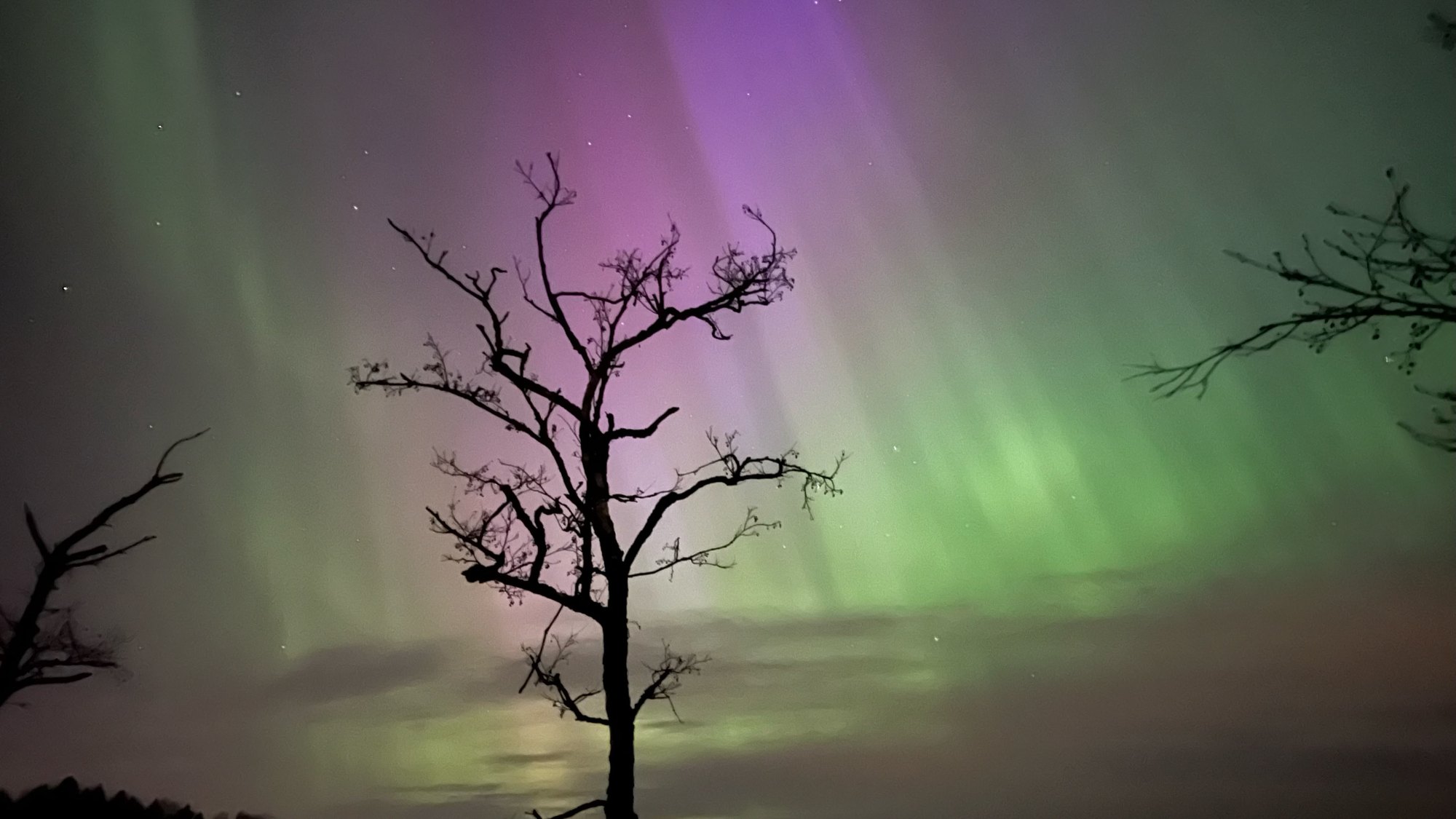
Everything below reduces to four things you can control. Get all four right on the same night and you will see something. Miss any one of them and you will not, no matter how good the forecast was.
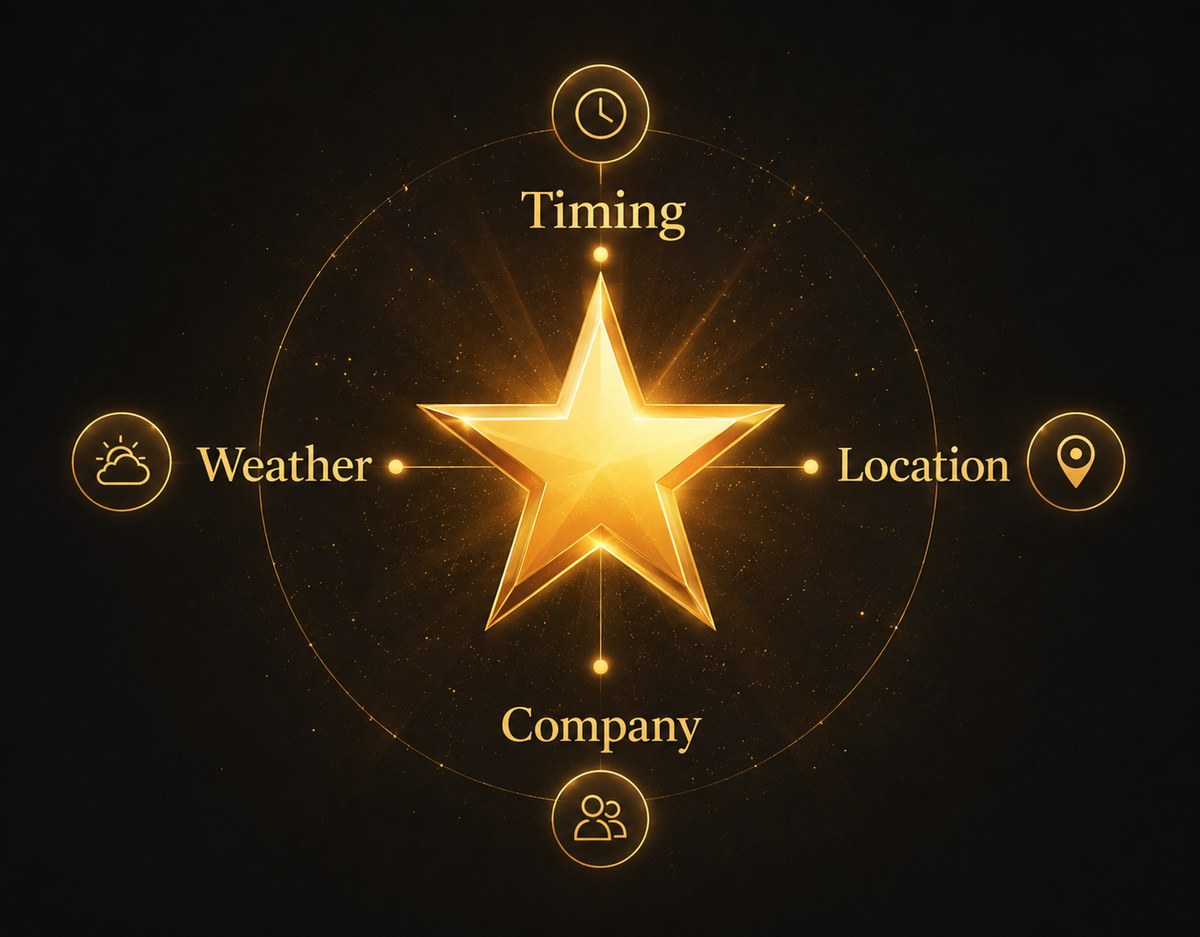
01Understand what you are chasing
You saw a photograph of colourful bright lights in the sky and now you want to see them too. You joined a group of people who are into this hobby and you keep asking them "Can I see them tonight? Should I go out now?" 😊
Invest a little time in understanding what you are after: how it happens, where in the sky to look, and which sources to trust. That investment pays back every single night you go out.
The very short version. The sun throws charged particles at us, either in a steady stream (the solar wind) or in violent bursts (coronal mass ejections). When those particles reach Earth and the interplanetary magnetic field happens to point south, they slip through our magnetic shield and slam into oxygen and nitrogen atoms high in the atmosphere. Those atoms light up. Oxygen at around 100 km gives the familiar green, oxygen much higher gives red, and nitrogen contributes the pinks and purples at the bottom edge of a strong curtain.
Treat this like weather. People make predictions, and the sky does not bend to your will. Either you put in the effort, or you make peace with looking at other people's photographs, or you depend on a friend who understands the numbers. All three are valid. Only one of them gets you outside.
02Location, location, location
You know what aurora borealis and australis are. You know which sites to trust, which apps to trust, and who in your group to trust. You know where to find a forecast and how to read it. You are feeling hopeful. Now comes the part that decides most of your nights.
Before you commit to a spot, ask yourself:
- Where exactly am I going to hunt?
- Have I been there before, at night or in daylight?
- Does it have a clean, dark view to the north and northwest? A lake, a sea, or a wide open field is ideal.
- How long does it take me to get there, door to tripod?
- Is there shelter nearby if the weather turns?
- What is the cloud forecast for that specific spot, not for the city?
Scout your viewpoints in daylight. Standing in an unfamiliar dark field at 1am, discovering a treeline exactly where the aurora is, is a special kind of heartbreak.
In an ideal world you live near the pole with a north-facing balcony and hunt in slippers. In the real world, being a few minutes from a decent viewpoint is an enormous advantage. If you live in Tampere or north of it, you already have that advantage.
If you are south of Tampere, do two things. Find and scout a genuinely good local viewpoint, and learn to chase only the stronger shows. Let the weak nights go. Or watch for a forecast with several promising days in a row and plan a trip north:
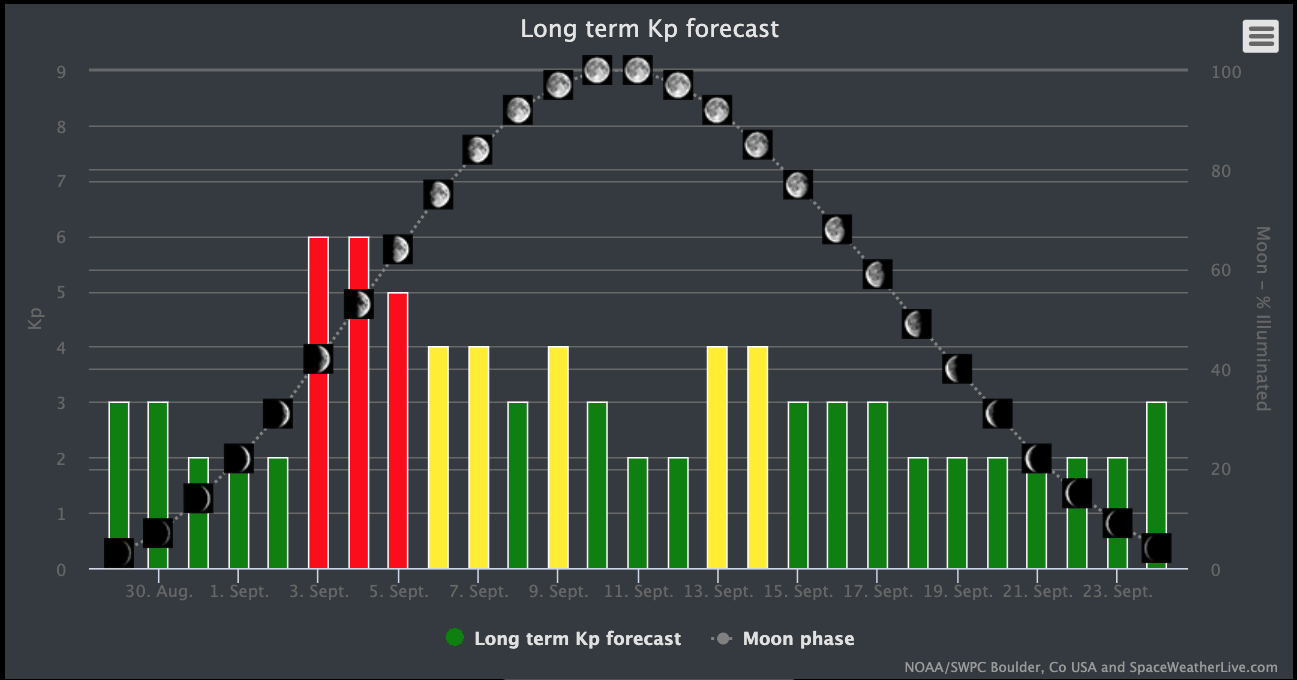
Two things to read off a chart like this. The obvious one is the run of red and yellow bars, which is your trip window. The less obvious one is the moon curve, and it is the reason two nights with identical Kp can give completely different experiences.
How far south can you realistically see them?
| Kp | What it means for you | Southern Finland |
|---|---|---|
Kp 3 | Quiet to unsettled | Lapland only. Stay in bed. |
Kp 4 | Active | Faint glow low on the horizon. Camera may catch it, eyes probably will not. |
Kp 5 | Minor storm (G1) | Worth going out. Visible arc to the north. |
Kp 6 | Moderate storm (G2) | Good show. Structure and movement visible. |
Kp 7+ | Strong storm (G3+) | Drop everything. Overhead activity possible. |
Kp is a blunt instrument. It is a planetary average, computed after the fact in three-hour blocks. It tells you roughly how far south the auroral oval has pushed, and nothing about what is happening in the next twenty minutes. For that you need the live solar wind numbers below.
03Reading the numbers
This is the part most people skip, and it is the single biggest difference between hunters who catch shows and hunters who read about them the next morning. Learn four numbers. That is all.
| Number | What it is | Quiet | Get interested | Go now |
|---|---|---|---|---|
| Bz | Direction of the magnetic field. Negative means southward, which is what opens the door. | 0 to +5 nT | -2 to -5 nT | -10 nT or lower, sustained |
| Bt | Total strength of that magnetic field. Sets the ceiling on how good it can get. | under 5 nT | 10-15 nT | 20 nT or higher |
| Speed | How fast the solar wind is arriving. | ~300 km/s | 400-500 km/s | 600+ km/s |
| Density | How many particles are in that wind. | under 5 p/cm³ | 10-15 p/cm³ | 20+ p/cm³, or rising fast |
The pattern worth memorising. Bz sitting at -8 nT or lower for twenty minutes or more, with Bt above 15 and speed above 450, means go outside. Not "check again later". Outside. Ground-level aurora typically follows within roughly 15 to 45 minutes.
Two things people get wrong here.
Bz is about persistence, not spikes. A dip to -12 that recovers in three minutes does very little. A steady -6 that holds for an hour builds a real show. Watch the shape of the line, not the peak value.
Bz is the gate, everything else is the fuel. Speed of 700 km/s with Bz sitting at +10 gives you nothing at all. The door is shut. High Bt only matters if Bz points south, because Bt is the size of the pool that Bz draws from.
04Timing
So you are nearly an aurora nerd now, and you know a great viewpoint twenty minutes away. And yet you keep missing shows that other people catch, sometimes at the exact spot you were standing an hour earlier. Maddening 😿
Almost always, the fix is timing rather than knowledge.
Do not wait for photos in the group
By the time someone posts a picture, you are usually late. Still worth trying if the live numbers look strong for the next hour, but you are chasing rather than meeting the show. Know the numbers yourself, or make sure at least one person in your hunting group does.
Widen your window instead of narrowing it
There is a predicted arrival window for a storm, and it has real error bars, often several hours wide. Most people go out at the centre of that window, wait twenty minutes, and drive home. Plan to stay an hour on either side of the estimate instead. The show does not check its watch.
Let the north tell you what is coming
Aurora reaches higher latitudes first. If the all-sky camera at Hankasalmi or Nyrölä is lighting up while your sky is still empty, that is your cue to leave. Do not confirm it with your own eyes first. Leave.
Watch the moon, not just the sun
A full moon washes out faint aurora the same way a streetlight does, and it is the variable almost every beginner forgets. Most forecast charts plot the moon phase alongside the Kp bars, so use it. A Kp 5 on a new moon night will look better to your eyes than a Kp 6 under a full one.
That said, do not treat moonlight as a reason to stay home. A bright moon lights up the landscape beautifully, and for a strong show it costs you very little. Save your new moon nights for the marginal forecasts, when every bit of darkness counts.
Know your local sky clock
Magnetic midnight in Finland falls roughly between 21:00 and 23:00 UTC, so late evening through around 01:00 local time is statistically your best stretch. But substorms fire whenever they want. Some of my best shows arrived at 19:30 and some at 03:00.
Season matters more than anything on this page. From roughly late May to late July, southern Finland never gets properly dark and hunting is simply off. The real season runs late August through early April, and the equinox weeks around late September and late March are historically the most productive of the year.
Dress to outlast your patience
The longer you stay out, the more you see. It really is that simple. Warm boots, real layers, and something to sit on will keep you out for two hours instead of twenty minutes. Some people bring a sleeping bag or a thermos and turn it into an evening rather than an errand.
05Tools I actually use
There is no shortage of aurora sites. These are the four I open on an actual hunting night, in this order, plus one I send to friends who are planning a trip. Everything else is noise I have stopped checking.
1. Jemma: tonight's call
My first stop, every time. Forecast for tonight in Finnish time, a global activity image, and a set of gauges that turn raw numbers into something you can actually decide on. This is the page that answers "do I go out or not".
It is popular enough that it goes unresponsive on exactly the nights everyone is checking it. When that happens I fall back to SpaceWeatherLive real-time auroral activity, which shows the same live picture in a different shape.
2. NOAA 3-day forecast: planning ahead
For the next three nights rather than this one. Useful for deciding which evening to keep free, or whether it is worth driving somewhere further out later in the week.
3. Tampere sky camera: ground truth
Run by Tampereen Ursa. The most reliable camera for our part of the country. It is not always on, but when it is, it settles the argument between the forecast and the sky.
4. Northern Lights alerts: on the phone
Real-time push alerts so I do not have to keep refreshing anything. Alerts tell me to look up. The first three tell me whether to drive.
5. Long term Kp forecast
The link I send when someone asks which week to book. Longer-range aurora forecast with the solar cycle context behind it, which is the honest answer to "when should I come to Finland" better than any single night's numbers.
The pattern matters more than the list. One page for tonight's decision, one for the week ahead, one camera to check reality, and one app to nudge me when I am not watching. If you build your own set, build it in that shape. The fifth is for a different question entirely, asked from another country, months in advance.
And then there are clouds
None of the four above will save you from an overcast sky, and this is where most southern Finnish hunts actually die. Check a high-resolution cloud model for your specific viewpoint, not a city-level forecast. Ventusky and FMI both work well. A gap in the clouds at your second-choice spot beats perfect numbers under a solid deck at your favourite.
06Hunt with friends
Alone, you get bored, you get cold, and you leave ten minutes early. That ten minutes is where a surprising number of shows live.
Bring at least one other person. Better still, build a small hunting party where somebody watches the numbers, somebody watches the clouds, and somebody brings coffee. Local aurora groups on Facebook and Telegram are worth joining for the same reason: real-time eyes spread across a wide area beat any single forecast.
Share what you see, including the nights when you saw nothing. Negative reports are genuinely useful data for everyone else who is deciding whether to get in the car.
07Gear and camera settings
What to bring
- Proper thermal layers, warm boots, hat and gloves. Cold ends more hunts than clouds do.
- A red-light head torch, so you keep your night vision and do not ruin anyone else's photo.
- Sturdy tripod. Every aurora exposure is a long exposure.
- Spare batteries kept warm in an inside pocket. Cold drains them alarmingly fast.
- Thermos, snack, and something to sit on.
- Offline map, and tell someone where you are going.
- Power bank. A dead phone in a dark forest at -15 °C is a real problem, not an inconvenience.
Camera settings to start from
| Setting | Start here | Why |
|---|---|---|
| Mode | Full manual, RAW | Auto exposure has no idea what to do with this scene. |
| Aperture | Widest you have, f/2.8 or faster ideally | Light is the entire problem. |
| Shutter | 3-10 s | Faint and static, go longer. Fast and dancing, go to 2-3 s or the structure smears away. |
| ISO | 1600-3200 | Push higher for a dim show, pull back for a bright one. |
| Focus | Manual, on a bright star via live view zoom | Autofocus will hunt forever in the dark. Set it, then tape it. |
| White balance | ~3500-4000 K | Auto swings wildly between frames. Lock it for consistency. |
A modern phone in night mode does surprisingly well now, and for many nights it is genuinely enough. Prop it against something solid, because even phone night mode wants a few seconds of stillness.
08Realistic expectations
This is the section I most want you to read.
When people post photos, they are using long exposures and sensors that gather far more light than your eye ever will. That creates an impression that the show was spectacular, when to the naked eye it may have been a soft grey arc. Be aware of that before you judge your own night as a failure.
If you hunt long enough from southern Finland, fewer than five percent of the shows you catch will look to your eyes like the pictures that got you into this. Photograph a quiet one and you will see the difference immediately: the camera pulls out green that your eye reads as pale grey.
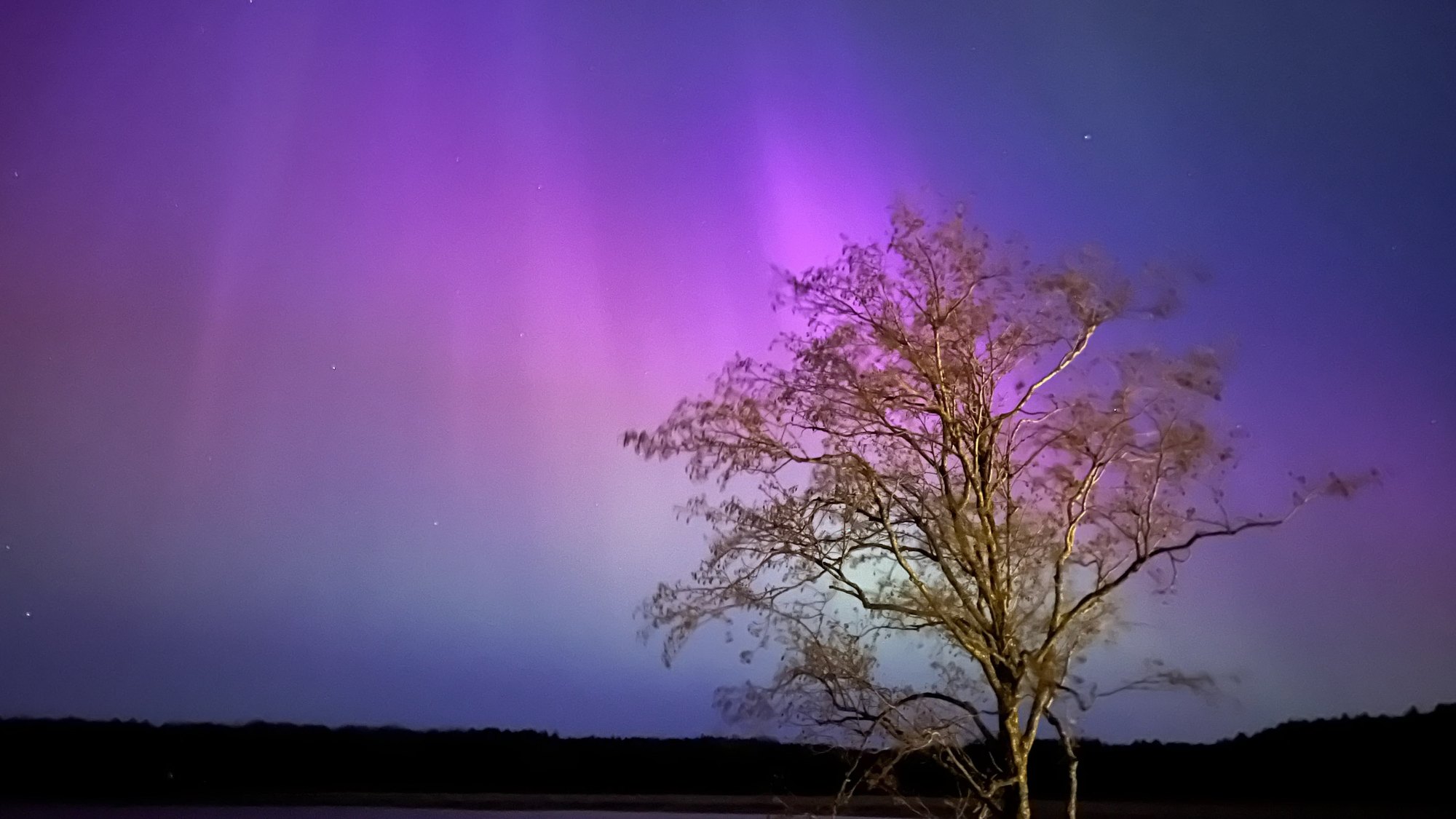
Your eyes are not broken and your night was not wasted. You are seeing exactly what a human sees. The camera is the one exaggerating.
A few things that help. Give your eyes a full twenty minutes to dark-adapt and keep your phone screen off or dimmed to red. Look slightly to the side of a faint patch rather than straight at it, since your peripheral vision is far more light-sensitive. And check a suspicious grey band with a single test photo, because a grey cloud stays grey while a grey aurora comes back green.
Set expectations accordingly, and then keep going out. With a bit of luck, the next one is in that five percent 🤩
09The 2026 window
Solar activity runs on a roughly eleven-year cycle, and Solar Cycle 25 peaked around October 2024. It considerably overperformed its own forecast, reaching sunspot numbers well above what was predicted.
We are now in the declining phase. That sounds like bad news and mostly is not. The years just after a solar maximum are historically excellent for aurora, because long-lived coronal holes send fast solar wind streams at Earth on a recurring pattern. 2026 and 2027 remain strong years, with the trend gently downward from here.
Translated into practical terms: if you have been meaning to get serious about this, the next couple of seasons are a good time. The window after that gets slower, and the following maximum is around 2035.
10The short version
- Scout two or three dark viewpoints with an open northern horizon, in daylight, before the season starts.
- Learn four numbers: Bz, Bt, speed, density. Bz is the gate.
- Bz at -8 nT or lower, held for twenty minutes or more, means go outside now.
- Check clouds for your exact spot, not your city.
- Watch the northern all-sky cameras as an early warning.
- Bring a friend, dress properly, and stay out longer than feels reasonable.
- Expect grey to the eye and green to the camera, most of the time.
- Go out on the marginal nights anyway. That is where the surprises live.
All the best, and clear skies.